
Overview of Bitwig Studio 6 v6.1:

Bitwig Studio 6 v6.1 Patched is the one-stop solution for turning musical ideas into reality at every stage of production. Simplify your creative process and quickly develop your ideas into songs, tracks, and complete compositions. Bitwig Studio provides intuitive tools for recording, editing, and organizing any material.
You may also like JRiver Media Center + Crack
Bitwig Studio 6 v6.1 Key Features:
-
Audio That Works For You
Audio clips are blocks of your music, and editing can be done there. Divide at the start, repeat with curves, or scale and stretch in different ways. And when the tempo changes, your audio will adapt to it, thanks to our over time options and those of Zplane.
-
Notes That Do More
Our notes are dynamic, allowing for microtones, accents, panning, and more for each note. So get true polyphony from Bitwig instruments, or send those notes as MPE or CV signals. Or even add musical logic with operators, modulating when and how notes are played.
-
Audio Comping, Anywhere
The compilation is a clean workflow for recording and then combining the best parts of multiple captures. It works on any audio clip on Bitwig, so it moves freely between the arranger and the launcher. Even long audio trails can be “bent” to create new compositions, exploring old tapes in new ways.
-
Polymer
Polymers start simple: choose an oscillator, a filter, and an envelope generator. Replacing the Grid module in a dedicated synthesizer is quick and easy, helping you create production-worthy sounds immediately from minimal commands.
-
Sampler
Bitwig Studio Sampler is a powerful tool for playing and manipulating audio. It offers several playback modes, an advanced looping function with crossfades, endless modulation possibilities, a great multisample editor, and much more.
-
Phase-4
Meet Phase-4, a four-oscillator synthesizer powered by phase modulation and phase distortion. This unique synth can play classic, modern, and beyond.
-
EQ+
EQ+ is a feature-rich graphic equalizer with up to 8 bands, mouse gestures, and excellent visualization and algorithms.
-
Drum Machine
A drum machine is a container device that you can fill with sonic goodness. It’s never been easier to create a unique, great-sounding kit.
-
Arpeggiator
Individual controls for stride speed, stride length, and pitch. 17-tone models and three-octave management modes. Full MPE support. It even modulates time for shift patterns. Holding chords has never been so musical and dynamic.
-
Micro-pitch
The micro-pitch is a Note FX device that lets you fine-tune pitch in new ways. Change the scale, fine-tune individual notes, lower or widen the octave, or even slice the octave into different parts. Play something unimaginable today.
-
Amp
Inject some virtual analog grit into your sound with the Amp Kit, an incredible amplifier simulation technology.
-
Convolution
Convolution is an effect that can transport any sound anywhere, even where it is not. All convolutions give your voice “pulses”, and our sound is complete with 270 of them, from 12th-century cathedrals and legendary studio effects to more abstract “environments”.
-
Delay+
Delay+ is Bitwig’s latest boutique audio effect. By balancing familiar controls with new, unobtrusive controls, Delay+ can add a bit of character or completely change your voice when playing ping pong.
-
Modulation Heaven
Bitwig Studio’s modulation system lets you use Macro, Note Expression, LFO, and Envelope controls to modulate any device, VST plug-in, or hardware parameter. With over 30 modulators (and counting), the potential for creative expression is limitless.
-
Hardware Integration
Let Bitwig Studio 6 v6.1 Full Version control your hardware, or let your hardware control Bitwig Studio, or both, via MIDI, CC, CV, Gate, Analog, and MIDI Clock, and MIDI Timecode. Enjoy a collection of simple tools that let you enjoy the best of both worlds and adapt to your setup.
-
Crash Protection
Bitwig Studio handles VST and CLAP plugin hosting uniquely, allowing for different hosting modes and protection against plugin failures. With plug-ins, audio engines, and other processes running on separate threads, technical issues won’t bring your entire project to a halt.
-
Touch Support
With extensive touchscreen support (multi-touch with unlimited touch points, gestures, pen support, and simulated pressure), Bitwig Studio is at the forefront of new ways to create music. Overall, Bitwig Studio’s user interface is tactile; in addition, there is a dedicated tablet display profile, suitable for any touchscreen or devices such as Microsoft Surface computers.
-
Essential Patterns
Essential Patterns is a customizable collection of Bitwig Studio Clips (basslines, chord progressions, melodies, etc.) that can include MIDI notes and messages as well as device presets…
-
Grand Piano Lite
Grand Piano Lite is a professionally sampled stereo recreation of the famous Bösendorfer grand piano, a lighter version of our larger Grand Piano set.
-
Essential Presets
Essential Presets is a versatile set of content generated by Bitwig and includes most device presets from Bitwig Studio.
-
Evolving Sounds and Sequences
The sound design comes alive with modulation.
-
Bitwig Wavetables
Carefully designed wavetables in five categories: real-world acoustic instruments, various analog and digital synthesis techniques, recursive fractal spectra, and various harmonic circuits.
-
Polymerics
This pack explores the vast sonic terrain unlocked by our fun and simple Polymer synthesizer.
-
Bass-08
The Bass-08 is a digital rebirth of the legendary 808 drum machine, made possible with state-of-the-art technology from Bitwig Studio.
-
Electric Keys
Electric Keys brings the original sound to life and reuses it as a modern show at Bitwig Studio.
-
Notes in Motion
The Notes In Motion package includes over 30 patches that generate music, rearrange the arpeggiator, note sequencer, and repeater, provide a modular drum interface, and more.
-
Bitwig Impulse Response
Your voice propagates using Bitwig Impulse Responses, the companion package to our Convolution suite.
-
Perfect Drift
Perfection is one of the greatest myths of humanity. That’s why Perfect Drift Sound Pack presets embrace nature’s asymmetry to approximate the beauty of imperfect analogs.
What’s new in Bitwig Studio 6 v6.1?
(Released on 26-08-2026)
One Sampler, All the Stops
- Joining our single and multisample options, Sampler now offers a sliced Sampler configuration, loading one audio file with various methods for triggering at points within the file.
- Root key is now an old way of thinking with new dynamic pitch detection and the Analyzed Root Key option.
- The new
Spectralstretching mode is the product of modern advances and in-house DSP work. - The new
Fragmentsmode puts playful, versatile granular in your hands. - The original
Repitch,Cycles, andTexturesplay modes now offer various character options for a ton of new possibilities. - You can now drag a sample — or samples — straight into a new Sampler device with various preset configurations.
- Plenty of other new workflows and sounds await in any flavor of Sampler.
Sliced Sampler, with new ideas
- When using a sliced Sampler, the blue Slicing Start and Slicing End markers determine the section of audio to be sliced.
- These are analogous to Single mode’s yellow Play Start and Play End markers.
- Like the single-file Sampler mode, the Expanded Device View duplicates the waveform/slicing interface, so you can have that larger (or popped-out) if needed.
- Slicing Mode options include:
Divisions, cutting the sample into a Number of Equal Pieces (default8, maximum64).- In this mode, every slice is the exact same length.
- This can be nice when playing polyphonically with one of the looping Playback Mode options.
- When working with pad triggers, setting the Number of Equal Pieces to the number of pads you have makes the entire sliced sample available.
- In this mode, every slice is the exact same length.
Beats, to cut at a fixed Beat Length of Each Slice (default16th note, ranging forWhole notetoTriplet 32nd note).- This mode uses and displays the detected BPM of the file.
- By turning off the Automatic BPM Detection toggle, the file tempo can be set manually.
- When set to an interval longer than eighth notes, gray subdivision lines will be shown on the waveform.
- This mode uses and displays the detected BPM of the file.
Onsets, to cut at the sample’s transients.- An Onset Sensitivity control (default
100 %, using all onsets) lets you remove weaker onsets. - A good choice for rhythmic material.
- An Onset Sensitivity control (default
Pitch, to cut at detected pitch changes.- When enabled, the sample is analyzed, and its detected pitch track is shown in orange.
- A Pitch Sensitivity control (default
70 %) adjusts the confidence, with a lower percentage resulting in fewer slices. - This can be nice for any monophonic material with pitch changes, such as a vocal line or bass parts where you want slices where the pitch changes.
Manualmode, for defining your own slices.- Switching straight into this mode begins blank, with no slices.
- Manual slices can be added with any Slicing Mode, alongside computed slices:
- Computed / mode-based slices appear yellow.
- To add a manual slice: double-click in the top half of the waveform. The manual slice will be a mint color.
- To remove any existing slice: double-click its handle. This will work for computed (yellow) and manual (mint) slices.
- Changing the Slicing Mode or its parameters will recreate computed slices that were deleted.
- Interacting with the bottom half of the waveform display offers zoom and scroll functions:
- When hovering, the magnifying glass icon is shown.
- Dragging up and down zooms the waveform in and out.
- Dragging left and right pans/scrolls the waveform.
- Double-clicking toggles between 1) zooming-to-fit the relevant parts of the waveform, and 2) zooming to show the entire sample.
- These are the sample interactions available in both single Sampler editing and in zone editing of a multisample Sampler.
- To move any existing slice: drag the handle at the top of the slice. For a computed slice, this will convert it to a manual slice.
- Manual slices will stay in place, even when you switch Slicing Mode.
- To delete all manual slices: right-click the Sampler waveform and choose Slices > Clear all manual slices.
- To commit all automatic slices: right-click the Sampler waveform and choose Slices > Convert all Slices to Manual Slices.
- A good general workflow is starting with a computed slice mode, and then making manual adjustments as needed.
- Slices can be triggered by:
All keys, using black and white keys.- Offers the First Slice Note parameter (default
C1), which sets the first note to assigned. - Will assign successive slices to the next MIDI key, until they run out.
- Offers the First Slice Note parameter (default
White keys, skipping all black keys.Black keys, skipping all white keys.- These modes also use the First Slice Note parameter, starting at that note or on the next matching note.
- Both modes can quickly provide your desired layout.
- In combination with the Instrument Layer device, you can access two sliced Sampler devices from one MIDI keyboard, etc.
- In all three key-triggered modes, Key Tracking is disabled.
Velocity, using note strength to select which slice is triggered.- By leaving note pitch free, you can still play across the keyboard with Key Tracking on to transpose each slice.
- Each note played grabs a different piece of the sample, treating each slice like various ‘articulations’ to choose from.
- The Velocity Sensitivity parameter (in the device’s output section) still determines how much velocity messages affect volume.
"Select" parameter, using the Select parameter value at note on to choose which slice is triggered.- By leaving note pitch and velocity free, you can freely play across the keyboard with Key Tracking to transpose each slice and Velocity Sensitivity to use velocity to affect volume.
- Select can be controlled directly, via automation, or by any of Bitwig Studio’s 40+ modulator devices.
- This is the same Select parameter available when a multisample is loaded, similarly used there for selecting which zones to trigger.
- For all trigger modes (except
"Select" Parameter), a note clip icon appears nearby that can be dragged into your project.- This generates a project-friendly clip that will trigger all slices in sequence with correct timing.
- Sample parameters are taken into account, but device playback settings (such as Speed, etc. etc.) are not considered.
- Playback Mode options control how a triggered slice plays:
to Slice endwill stop playback when the slice boundary is reached.to Sample endwill stop playback only when the Slicing End is reached.- For these non-looping modes, using the One-shot envelope will continue to the end. And using the Gated envelope will stop after the note is released.
One-way loopingwill jump to the opposite slice boundary and keep playing.Ping-pong loopingwill reverse direction at slice boundaries and keep playing.- These looping modes require the Gated envelope, which will continue looping until after the note is released.
- Zone/Slice Source modulations are available, for customizing any slice.
- Like in multisample mode, three modulation sources are available — P₁, P₂, P₃.
- These polyphonic modulation sources can be mapped to any available Sampler parameter (or parameters of its nested devices and plug-ins).
- When one of these sources is in modulation mapping mode, dragging across the waveform lets you set a value for any slice (it looks like a step sequencer).
- Assigning modulations to a slice necessarily converts it to a manual slice.
- Holding [ALT] allows zooming on the waveform, so:
- [ALT]-drag zooms the waveform in and out — and when zoomed in, pans the waveform.
- [ALT]-double-click triggers the Zoom to Fit action.
- Slicing-related functions:
- With a clip selected, Slice / Fold > Slice to sliced Sampler action lets you bounce the clip straight to a new sliced Sampler instance.
- Right-clicking the device header of a sliced Sampler offers a Convert to Drum Machine option. This places:
- Each slice into its own drum cell with its own Sampler.
- If the P modulation sources were used for a slice, any targeted parameters are adjusted in that cell with the proper values (just as when they were modulated).
- A sliced Sampler can be transformed into a multisample by right-clicking on the waveform and choosing Conversions > Convert to multisample Sampler.
- This creates a multisample that responds the same way as it did before, taking the Slice Mode into account and all.
- This allows, for example, converting two or more sliced Sampler instances, and then merging them into a single multisample Sampler.
- Like multisample configurations, sliced samples can be saved.
- Right-click on a sliced Sampler waveform, and choose Save to Library from the context menu. A dialog will appear with name, creator, category, tags, and description options.
- These files are available from the browsers with the new Sliced Audio source.
- In the Browser Panel, the Samples + Clips parent source includes Sliced Audio as one of its sources.
- Files are saved using the PreSonus AUDIOLOOP open format.
Root Key tracking, changing everything
- Root key is the traditional sampling concept of defining the single pitch of a sample, allowing proper playback/transposition.
- Sampler’s new automatic pitch analysis detects the pitch track of your sample, and apply it from the current playback position.
- This is simply enabled by clicking the Analyzed Root Key option beside the ROOT label.
- After analysis completes, the pitch track of your sample will be shown over the waveform as an orange curve.
- The manual root key parameters are replaced by a Dynamic label.
- On playback, the pitch of the sample (and, when appropriate, the playback speed) will now be known and compensated for each moment of the sample.
- This means material that changes pitch can now just be played on the keyboard, regardless of how the material moves.
- With root key becoming a dynamic concept, any musical material is suitable to be dropped onto a Sampler, particularly monophonic clips in your project.
- This is simply enabled by clicking the Analyzed Root Key option beside the ROOT label.
- When Analyzed Root Key is disabled, the traditional Root Key and Root Key Fine Tune settings are available again.
- The new pitch analysis can also be used to set a fixed root note.
- Right-click the waveform, and from the Sample Settings menu, choose either:
- Set Root Key from Click Position, or
- Set Root Key to Average Pitch.
New Spectral mode, for sampler stretching, bending, and breaking
- Clean time stretching required a purpose-built algorithm.
- The new Spectral mode works for the clear cases, and can even full-stop to let you explore any sound.
- Two character modes are available:
Pureis meant for clean stretching.- When you toggle on Formant Processing, modulatable controls for Formant shift amount (±2 octaves) and Formant Shift Amount (a crossfade-type control) are active.
- The Inspector Panel also offers a Relative Formant Shift option. This takes pitch changes into account when Formant Processing is enabled (and adds keytracking-style arrows to the Formant Processing icon).
Reharmcan also tweak your harmonics and reharmonize your sound.- A Harmonic Bend control lets you shift the harmonics of the sound (±2 octaves) while leaving the fundamental in place.
- Harmonic Quantization Mode offers three choices for how to process harmonics:
Offdoes no harmonic correctionto Octavesshifts each harmonic toward the nearest octaveto Key, which shifts each harmonic toward the nearest in-key step. Key is defined by additional Inspector Panel parameters:- When Use Global Key is on (the default), the project’s Key Signature (Root Key and Scale) will be used.
- When Use Global Key is off, the Local Key and Local Scale/Mode parameters are used. Both of these device parameters are modulatable and polyphonic.
- When not
to Octavesorto Keyis used, a Harmonic Quantize Amount attenuates the amount of quantization being applied. - You can still toggle on Formant Processing, using preconfigured values.
- The Relative Formant Shift option is also available from the Inspector Panel.
- Both characters have a Preserve Onsets option.
- This changes the playback speed thru onsets (basically, ‘unstretching’ them) to keep their original character.
- The onsets are visualized on the waveform in orange.
- The Onset Sensitivity control lets you filter to fewer, stronger onsets.
- Additional parameters are available in the Inspector Panel:
- Phase Dispersion (default
66.7 %) is the amount of phase randomization applied at extreme stretching ratios, effectively smoothing the sound. This parameter is also modulatable. - Spectral Quality / Cost (
Low,Medium[the default],High, orUltra) adjusts the relative quality of pitch shifting and formant processing, as well as the processor and latency requirements. - Live Performance Mode (default On) delivers notes without latency but with higher processor costs at note on. When disabled, latency is produced so that processing costs are spread out more evenly.
- Phase Dispersion (default
New Fragments mode, for grain clouds, microloops, and beyond
- Myriad options await in the new Fragments granular mode.
- All of the main panel options are automatable and modulatable.
- Grain Size can be set either in time or as a beat unit (
16th notedefault). - Whatever the unit of Grain Size, Grain Density is set relative (
10by default, ranging from0.1to100).- These parameters can be uncoupled as well, offering a Grain Rate control instead.
- Grain Rate will follow the unit choice (time versus metronome interval) of Grain Size.
- Additionally, the Sampler Grid module has a Fragments Trigger In port.
- This mono port allows you to override the density/rate controls and create grains via signal input.
- This can be particularly useful when you have an event sequencer or other synchronized signal you’d like to re-use.
- Voice Stacking may be useful here, helping to overcome the limits of polyphony (which will only give you one active grain per voice).
- Like the Textures mode, a Motion control is available (from
0 %to800 %), providing randomization for each grain’s playhead as well as its stereo position. - A Grain Envelope curve allows morphing the amplitude envelope of each grain, from a quick-attack pluck sound, to something more open and sustained.
- Grain Repeats (from
1to16) sets the number of times that each grain is triggered.- The position of repeats is set by the Repeat at Initial Position toggle, in the Inspector Panel.
- Several additional grain-related parameters can be found in the Inspector Panel:
- Grain Playback Direction offers several modes:
Samplealways follows the set direction of the Sampler (forward or reverse).Playhead(the default) uses the current playhead direction at the time each grain is born.Randomrolls the dice for each grain.Alternatejust uses the opposite direction of the previous grain.
- Latch Initial Rate keeps the original rate of a grain for its entire lifetime.
- Grains Survive Voice End reactivates the current grains (from their current playhead position) when the voice is triggered again. This can result in a smoother sound, for some purposes.
- Maximum Grains per Voice lets you limit the number of grains available to each voice.
- Grain Playback Direction offers several modes:
Updated Repitch mode, now with characters of classic hardware
- Repitch has always offered traditional “tape machine-style” playback, where pitch and speed are coupled.
- Three character modes are now available:
Cleanis for basic playback, like before.- The Sampler Grid module has now gained a Repitch Phase In port.
- This allows you to perform phase modulation on any playing sample.
Analogdoes classic hardware warmth.- The Distortion parameter adds some Crunch.
- Internal pre- and post-EQ stages mean the distortion is dependent on playback rate — and each note in a chord will get its own flavor.
- The Color knob adds some stereo Tape saturation.
- Positive settings push the high end, lower the mids, and flatten the transients (more room tone).
- Negative settings push the low–mids, increase the tube feeling, and expand the transients (more POP).
- The Distortion parameter adds some Crunch.
Digitalbrings polyphonic clocks for (mis)alignment choices.- The Distortion control adds some Bits reduction.
- The Color control offers different flavors of sample-rate reduction, ranging from 90s hardware down to children’s toys.
- Positive settings make more “mistakes”, with heavier aliasing and punching up the high–mids.
- Negative settings are smoother and darker.
- Variable Sample Rate [on by default] takes playback rate into account for sample rate changes, meaning each note gets its own sample rate.
- Digital Imaging Filter adds a sample rate-dependent filter at the output stage (which is more proper and clean).
- The Repitch Distortion and Repitch Color parameters are shared between the
AnalogandDigitalcharacters, making it easy to audition each mode while keeping any automation or modulation applied.
Updated Cycles mode, now with synthesis characters
- Cycles has always extracted single waveforms as pseudo wavetables, along with a Formant shifting option.
- In addition to this ever-present Formant control, Cycles now has three synthesis-heavy characters:
Pulse, which supports pulse width-style modulation.- The bipolar Width parameter performs a positive or negative pulse-width modification.
- Whether it’s a slow LFO or anything else you’d try with PWM, you can now give some of that familiar sound to any sample.
Partials, which lets you push the odd or even harmonics.- The bipolar Split control isolates odd harmonics (when negative) or even harmonics (when positive).
- The Fund(amental) control inserts a sine wave at the played pitch, automatically following the voice’s current level and blending with the rest of the sound.
Phasemodulation mode, which support PM/FM by a harmonic modulator.- The Mod(ulation) amount control represents the depth/index of modulation from the dirty sine wave modulator applied to the sample.
- The Harm(onics) control steps between various tunings for the modulator oscillator.
- For smoother sounds, any character can use the Crossfade Two Voices toggle.
- This duophonic mode runs two Cycles voices instead of one and crossfades between them for a smoother sound (especially when Analyzed Root Key is enabled).
- When this mode is enabled, the Grain Size parameters used by other modes appear for setting the crossfade time, either in seconds or beat units.
Textures mode, with light updates
- Our classic granular mode remains largely the same, with a few enhancements.
- As with
Fragments(andCycles), the Grain Size can now be set in beat units as well, which often makes the sound more musical immediately.- Since these parameters and Motion are shared with
Fragments, auditioning the two modes is quite convenient, preserving your common settings — and their modulations — when you switch between the two play modes.
- Since these parameters and Motion are shared with
- The new Analyzed Root Key option can make a nice difference in Textures, feeding each grain with local pitch data.
Workflow Improvements
- Now you can drag one or more sample files straight onto a new or existing track to create preconfigured Sampler devices.
- When dragging one audio file to a track area:
- Dragging normally will Insert Sampler, using your default preset.
- [ALT]-drag will Insert stretched Sampler, putting the Sampler in
Spectralstretching mode. - [CTRL]-drag ([CMD]-drag on Mac) will Insert sliced Sampler, putting the Sampler into sliced mode.
- This also switches to the
One-shotenvelope mode, and puts the device in Digi Mono mode, which will choke playing slices when a new one is triggered.
- This also switches to the
- When dragging multiple audio files to a track area:
- Dragging normally will Insert round-robin Sampler.
- This loads all samples into one multisample, stretches the zones to cover all notes, and sets every zone to Round-robin mode so that each note triggers the next sample.
- [ALT]-drag will Insert Drum Machine, loading your samples from pad C1 and up.
- [CTRL]-drag ([CMD]-drag on Mac) will Insert tuned Sampler.
- This loads all samples into one multisample, stretches the zones to cover all notes, and then sets the root note of each zone either from the filenames or by running the Set Root Key to Average Pitch function.
- The result is a playable multisample.
- Dragging normally will Insert round-robin Sampler.
- In a Drum Machine device where each cell only receives one note, some alternate choices are offered (Insert layered Sampler is like Insert tuned Sampler but without root key analysis), and other choices that don’t make sense (Insert sliced Sampler) aren’t offered.
- When dropping samples into empty areas of the Grid editor, Sampler-specific choices (Insert round-robin Sampler, Insert layered Sampler, and Insert tuned Sampler) are offered.
- When dragging one audio file to a part of your device chain where audio is expected (such as after an instrument, or into an FX chain), this will Insert Convolution and load it with your chosen sample.
Other Sampler Improvements & Changes
- Use Project BPM is available beside the Speed knob as a metronome icon.
- The sample’s tempo will be automatically detected, or can be set manually.
- This toggle makes playback speed calculations include the project tempo.
- When enabled, changing the project BPM will also change the playback speed of this Sampler.
- There are now three snap options when dragging visual handles on the waveform:
No snappingallows free editing.Snap to onsetswill snap only at detected onsets.Snap to zero crossingswill snap at every, well, zero crossing.- When using
Snap to onsetsorSnap to zero crossings, holding [SHIFT] will disable snapping for the current interaction.
- The loop region can now be moved without changing its length.
- When you have a defined loop region (in single or multisample modes), you can now [ALT]-drag the loop region to move it as a whole.
- The length with be preserved, and if necessary, the crossfade will be adjusted.
- You can still drag the various handles — Loop Start, Loop End, and Crossfade Length — to adjust those individual parameters directly.
- New options for how to handle loops at note off.
- When using one of the active LOOP modes (One-way Looping or Ping-pong Looping), three options are available for what to do At Note Off:
Remain in loopkeeps the normal rules, constraining playback to the loop region during release.Continue freelykeeps playing from the current position, but will be free to pass the Loop End point.Exit loop immediatelywill jump to the Loop End point at note off, letting you choose which section of the sample to play on release.
- These choices are available in the LOOP menu.
- When using one of the active LOOP modes (One-way Looping or Ping-pong Looping), three options are available for what to do At Note Off:
- Select parameter can now dynamically change multisamples.
- The Select parameter allows another dimension (together with key and velocity) for choosing which zones to trigger.
- The new Live “Select” Updating option makes the Select parameter into a realtime control.
- This requires a multisample with programmed Select value ranges (and Select Fade values for smooth transitions).
- For multisample editing:
- Zones now have Mute and Solo toggles, which are nice while editing.
- When multiple zones are selected, the Inspector Panel now offers standard Histogram editing for Zone Parameter values and other parameters.
- By clicking the button at the right end of any of these values, the value range is visualized along with controls to shift the data’s Mean, Scale their distribution, or inject some Chaos.
- New zone actions are available to:
- Set Root Key to Average Pitch, which uses the new pitch detection for determining the value.
- Distribute Key by Root Key, which will take multiple selected zones and give them appropriate ranges based on their root keys.
- For the Sampler device, the filter has added an EQ-friendly Bell option.
- Choosing this adds a Bell Filter Gain parameter (default
+6 dB) for boosting or cutting most subtly. - Since this is on the instrument, it is applied polyphonically where Filter Keytrack (and per-voice modulations) can make a big difference.
- Choosing this adds a Bell Filter Gain parameter (default
- The Grid Sampler module can also provide its analysis as signals…
- The Enable Analysis Out Ports option (in the Inspector Panel) swaps out the P₁, P₂, P₃ out ports for three others:
- Onset Out (yellow), sending out a brief signal at the onset’s intensity level when passed and zero when not at an onset.
- As a hybrid trigger signal, this gives you the detected onset intensity so you can filter as you like.
- Pitch Out (orange), outputting the analyzed pitch of the current playback position in Bitwig’s standard pitch format.
- Envelope Out (blue), outputting the analyzed amplitude of the current playback position.
- Onset Out (yellow), sending out a brief signal at the onset’s intensity level when passed and zero when not at an onset.
- All analysis out ports on this module are mono, and the values are output as each block (as is the analysis itself).
- This could allow you to:
- Trigger elements whenever onsets are passed in your sample.
- Send the current pitch value of the sample to other modules (which can be polyphonic), or via the CV Pitch Out module to your hardware (probably better when mono).
- Use the amplitude of each voice to shape other oscillators to correspond to the sample’s current level on each voice.
- Other unfathomable things.
- The Enable Analysis Out Ports option (in the Inspector Panel) swaps out the P₁, P₂, P₃ out ports for three others:
- A few notes on changes to Sampler:
- Some parameters that could previously be modulated or automated are no longer offered. This includes:
- Play Mode
- Freeze Playhead
- Envelope Mode
- The set parameter values will be loaded by Sampler in v6.1, but modulation/automation will be disregarded.
- If you were modulating/automating these parameters, you can load your project in a previous version of Bitwig Studio and make any adjustments there.
- Friendly reminder: Loading an old project in a new version of Bitwig Studio immediately backs up your old file (in your project folder’s auto-backups folder, where a version folder is added).
- Many other new toggles and mode switches are also not modulatable/automatable, as they trigger audio engine updates and kill active notes. This is by design.
- Some parameters that could previously be modulated or automated are no longer offered. This includes:
New Tuner device, Grid module
- There is now a Tuner (Analysis) device.
- It visualizes:
- The relative tuning of the current moment, as spokes that turn green when you approach in tune.
- A text block displaying the current closest note, with cents offset above and frequency below.
- A history chart of how “in tune” recent notes were. It can be helpful to both see performance history and display pitch envelopes of various instruments/patches.
- It has two parameters:
- Silence Threshold (from
-96.0 dBto0.0 dB), setting the minimum level required for tuning. - Reference Frequency (A3) (from about 415 to 466 Hz; matching the range in Micro-Pitch [Note FX]), a frequency offset applied to the entire note range, set as the tuning for A3 (traditionally
440 Hzand the default).
- Silence Threshold (from
- The new Tuner (Display) Grid module offers the same options in a smaller footprint, so:
- The text block is always shown.
- Only one Graph Style is shown at a time (either
PresentorHistory). This can be changed by right-clicking the module, or from the Inspector Panel. - Both functional parameters are also in the Inspector Panel.
New Features
- Controller script added for Reliq-Instruments Reliq
- Controller script added for Embodme Erae 2
- Controller script added for Native Instruments’s NKS Connect protocol
General Improvements
- Onset filtering functions thru out the program now use a “sensitivity” orientation:
- A value of
100 %means all onsets will be used. - This replaces the previous “threshold” orientation used in:
- Various functions that could incorporate onset filtering, such as Slice in Place and Quantize Audio.
- Audio events that make use of Onset Sensitivity (previously called Onset Intensity Threshold, and whose values have now been converted).
- The Intensity value of onset events is unchanged.
- A value of
- Special parameters (such as Play Mode and Envelope Mode of Sampler) can also use the Copy Value to All Layers action:
- Container devices that are made for layers/chains include:
- Drum Machine
- Instrument Layer & Instrument Selector
- FX Layer & FX Selector
- Note FX Layer & Note FX Selector
- In these Container devices, layers with similar devices offer special “Copy” actions on right-click.
- For example, if multiple layers are using Reverb devices, right-clicking on one device’s Reverb Time parameter offers a Copy Value to All Layers (#) option [where (#) shows the number of layers that will be affected].
- Note: For modulatable parameters, the right-click menu also offers a Copy Modulation to All Layers (#) option for each individual modulation routing.
- The option is now available to certain non-modulatable parameters. In the Sampler device/Grid module, these parameters include:
- Play Mode, Envelope Mode, Freeze Playhead, and Use Project BPM.
- In
Repitchmode, this includes the Repitch Character setting, as well as the Variable Sample Rate and Digital Imaging Filter toggles. - In
Spectralmode, this includes the Spectral Character and Harmonic Quantization Mode settings, as well as the Preserve Onsets and Enable Formant Processing toggles, and all Inspector parameters. - In
Cyclesmode, this includes the Cycles Character setting, as well as the Crossfade Two Voices toggle. - In
Fragmentsmode, this includes all Inspector parameters.
- This also applies to other devices that use this type of parameter. So nearly all device parameters can now use the Copy Value to All Layers action.
- Container devices that are made for layers/chains include:
- Automation workflow improvements:
- Hold point creation is now fully under user control:
- Clicking to insert the first automation/point to a line (or double-clicking off an existing curve) creates a non-Hold point.
- If the point lands after a Hold segment, that segment will become linear, with a support point added at the end.
- Holding [CTRL]-clicking (or [CMD] -clicking on macOS) inserts a Hold point instead.
- Clicking to insert the first automation/point to a line (or double-clicking off an existing curve) creates a non-Hold point.
- When moving existing automation points (or the end of a Hold segment), the event’s initial position is always used as a snap point.
- Redundant points, etc., are better cleaned-up after move/insert operations.
- Snap to semitones no longer refuses to snap back to the original value.
- Hold point creation is now fully under user control:
- Clip aliases: Merge Duplicate Patterns for Project is now accessible via the pattern chooser (both in the Inspector Panel and the context menu)
- Additional resolution is shown Hertz value readouts thru out Bitwig device panels. This includes:
- Micro-pitch (Note FX) device
- Tuner (Analysis) device
- Tuner (Display) Grid module
- Value Readout (Display) Grid module
- Pitch (Pitch) Grid module
- When dragging a clip within your project, the Bounce while dragging option is now mapped to [B], with additional source options of Pre-FX [1], Pre-Fader [2], or Post-Fader [3]
- Bitwig Studio’s browsers can now show Tuning Files.
- This will display any Scala (SCL) files that describe either seven- or 12-note scales.
- When a file is selected, any description from the file is shown (in the Pop-up Browser), as well as the number of NOTES.
- If a Tuning File is dragged in from the Browser Panel, a Micro-pitch device is created with the file loaded.
- If you then click the folder icon to Replace Content via the Pop-up Browser, your browsing session will start from the original SCL file.
- Simple interface modulators now have their controls set to
100 %when inserted, allowing you to start mapping immediately. These include:- Button (Interface)
- Buttons (Interface)
- Macro (Interface)
- Macro-4 (Interface)
- Phase-4, Polysynth, and Sampler (Synth) devices: Each device’s filter keytracking option now has a default value of
100 %when reset, such as by double-click. - Grid module adjustments:
- Key Quantize (Pitch) Grid module: This is the same module previously called by Scale.
- Semitone Quantize (Pitch) Grid module: This is the same module previously called by Semitone.
- Key Quantize and Semitone Quantize modules are now listed before Pitch Quantize in the Grid module palette, following with the general principle of simpler modules being offered first.
Fixes
- The Bounce, Bounce In Place, and Expand actions now use the project time signature again (instead of
4/4). - Touch screen: Dragging with touch or pen showed no feedback while moving, altho the drop still happened (a regression).
- A Raw Launcher clip now uses the tempo automated by its scene to generate its waveform.
- Merge Duplicate Patterns now also works from clip- and slot-selections, with the action applied to those tracks.
- Onsets deleted from an audio event no longer come back when the event is edited.
- Fixed some Detail Editor Panel related crashes.
- Fixed situations when loading a BWCLIP pointed to old values and couldn’t open parts of the editor.
- macOS: Window footer text and modifiers now update while dragging from the Finder into Bitwig Studio.
- In a particular project with tempo automation, global playback can now start before bar nine.
- No more lag/freeze when dragging samples into a track using a high-polling-rate gaming mouse.
- VST3: Fixed reading of
Presonus\::ContextInfo\::kColorformat - Controller script fixes:
- Novation LaunchControl 3 and LaunchControl 3 XL: small display improvements
- Sensel Morph and Livid Controllers: Selecting a track no longer automatically switches to the Detail Editor Panel
Screenshots:
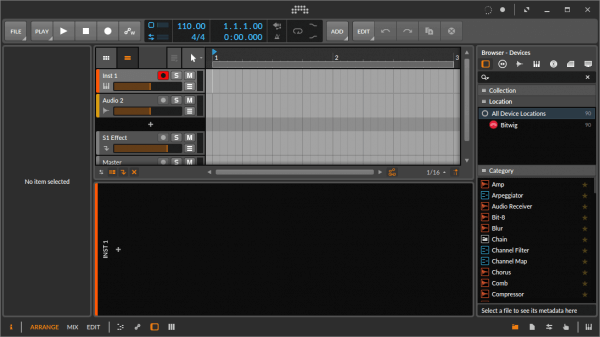
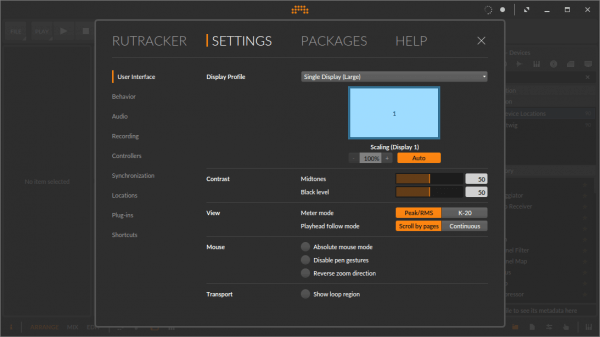
System Requirements:
- Operating System: Windows 7/8/10
- RAM: 1 GB RAM (2 GB recommended)
- Hard Disk Space: 200 MB or more
Bitwig Studio 6 v6.1 Full Version Download from the link given below: