

Overview of Altium Designer 26.8.1 Build 31:

Altium Designer 26.8.1 Build 31 Cracked makes it easy for engineers to connect with all aspects of the electronics design process. Over 35 years of innovation and development focused on a truly integrated design environment make it the most widely used PCB design solution.
Altium Designer 26.8.1 Build 31 Key Features:
-
Design Review Use Case
Design reviews are essential for success. Capture design discussions via contextual comments in a web browser or Altium Designer Full Version to ensure comments are saved and processed efficiently.
-
Electronic Collaboration Use Case
Collaborate with other technicians all over the world. With Git-based version control and visual distinction capabilities, you can ensure that designers stay in sync at all times.
-
Customer Interaction Use Case
Keep your customers informed by sharing photos of designs or works in progress, accessible in a web browser from anywhere on any device.
-
Manufacturer Collaboration Use Case
Release your manufacturing and assembly data with confidence and allow your manufacturing partners to view and comment on your production data right in the browser.
-
MCAD Collaboration Use Cases
Stay in sync with your fellow engineers with two-way, file-less collaboration using native integrations with SOLIDWORKS, Creo, and Inventor.
-
Software Collaboration Use Case
Debugging the hardware does require design access. Embedded software engineers can now find, select, and cross-search schematics, layouts, and 3D in the browser.
-
Remote Working Use Case
Remote work is no longer the exception but the norm. Whether you are at home, with a customer, at the airport, or anywhere in the world, working remotely has never been easier.
-
Anonymous Sharing Use Case
Discover the ultimate freedom with the ability to anonymously share photos of your creations with anyone in the world using a simple link. All they need is browser access; no registration is required.
-
Embedded Viewer Use Case
Want to show off your creations on your blog? Integrate your designs onto your site with just a few lines of code, delivering an immersive and fully interactive design experience to your users like no other.
-
Unified interface
Altium Designer 26.8.1 Build 31 Patch was designed from the ground up as a powerful single-application electronic development environment containing all the advanced design tools you will need to complete your design projects.
-
Global Editing
Altium Designer 26.8.1 Build 31 Keygen provides flexible and powerful global editing tools. Make changes to all or some components at once. The versatile selection tool lets you quickly find, filter, and edit the components you need.
-
Simple and Intuitive
Altium Designer allows you to easily create multichannel and hierarchical designs. Simplify a complex design into something visually pleasing and easy to follow.
-
Schematic-driven design rules
The design begins with a schematic, which is why Altium Designer allows you to define high-tech interfaces and their boundaries from the schematic editor.
-
Hierarchical and multichannel design
Simplify complex or multichannel designs into manageable logical sections with the Altium Designer Hierarchy Design tool.
-
Interactive Routing
Design the highest quality PCB layouts in no time with Altium Designer’s advanced routing engine that includes several powerful routing options such as walk, push, hug, ignore obstacles, push and push, and differential pairs.
-
Stackup Planning
The Layer Stack Manager has been completely updated and reworked, including impedance calculations, material libraries, and more.
-
3D Visualization
View and interact with your designs in real 3D with Altium Designer’s advanced 3D engine
-
Variants Support
Manage multiple variations of your designs without having to create separate projects or versions of your designs.
-
Real-time bill of materials management
ActiveBOM lets you automate by providing information on parts such as availability and pricing from specific suppliers, so there are never any surprises.
-
Powerful Part Search
In-person place and migrate electronic components that meet design, availability, and cost requirements with global parametric vendor searches.
-
Multiboard Assembly
Take the challenge of ensuring the shape and fit of multiple boards in one blanket.
-
Automatic project release
Altium Designer provides a controlled and automated design release process that ensures your documentation is simple, complete, and well-communicated.
-
Professional PCB Documentation with Draftsman
Draftsman’s enhanced features make creating your PCB fabrication and assembly drawings easier.
-
Reusable output configuration
Generate and drop your complete design in a simple and easily transferable package with reusable batch output in Altium Designer.
You may also like Advanced Installer Architect + Crack
What’s new in Altium Designer 26.8.1 Build 31?
(Released on 09-07-2026)
Schematic
- In some cases when switching between comments in a schematic, the error “Cannot set Visibility or call Show, ShowDialog, or WindowInteropHelper.EnsureHandle after a Window has closed” would be encountered.
- With a non-default path specified for ‘Local Templates folder’ (on the Data Management – Templates page of Preferences), navigating to that folder when loading a template for an open schematic document (using Tools » Design » Sheet Templates » Local » Load From File) would revert to the default template folder (\Users\Public\Documents\Altium\AD<Version>\Templates) between sessions of Altium Designer.
- In some cases when adding a footprint to a selected schematic component using the Footprint Manager, the error “Object reference not set to an instance of an object” would be encountered.
- In some cases when attempting to reset board level annotation after removing some components from a source schematic (or masking them with a compile mask), the error “Unable to cast object of type “Altium.WorkspaceManager.DataModel.DesignatorRecordAdapter” to type “Altium.WorkspaceManager.DataModel.DesignatorRecord”…” would be encountered. In another case, the error “startIndex (‘-9’) must be a non-negative value. (Parameter ‘startIndex’)…” was encountered.
PCB
- Added the ability to increase the number of signal layers in a PCB design from 32 to 128, using the advanced settings option ‘PCB.IncreaseSignalLayers’.
- For a specific design, adding via stitching or via shielding to a net with rule-driven solder mask expansion, would result in incorrect bottom solder mask expansion and the ‘link’ control being displayed in the wrong state.
- There was noticeable performance degradation when adding teardrops to a PCB, with the process taking a very long time and consuming a considerably higher amount of memory.
- With the PCB.Performance.InteractivePropertyPanel.Optimization option enabled (Advanced Settings) and the ‘Repour Polygons After Modification’ option enabled (on the PCB Editor – General page of Preferences), moving a component onto a polygonal pour, enabling Thermal Relief for a selected pad and changing the Connect Style, would result in the error “Value cannot be null. (Parameter ‘source’)” being encountered.
- In some cases when running a DRC of the Acute Angle design rule, an Access Violation (in module “ADVPCB.DLL”) would be encountered.
- When creating a new rule (by adding or duplicating) in the PCB Rules and Constraints Editor dialog, the Name field is now given focus by default.
- When using the teardropping feature, copper keepout tracks were being ignored and incorrect teardrops created, if the area with those keepouts was panned to be outside of the visible display area.
- In some cases when recalculating impedances for an impedance profile in the Layer Stack Manager (e.g., Type ‘Differential-Coplanar’, with Roughness Model Type ‘Hemispherical’), the error “The transaction has aborted. — System.Reflection.TargetInvocationException: Exception has been thrown by the target of an invocation…” would be encountered.
- The ‘ODB++ Intellectual Property Protection’ feature, delivered by the ODB.IntellectualPropertyProtection option (Advanced Settings), is now officially made Public with this release (ON by default).
- When using the PCB CoDesign feature, a silent crash would be encountered when comparing empty length tuning accordions.
- In some cases when working with a PCB Library document, an Access Violation (in module “ADVPCB.DLL”) would be encountered.
- In some cases when defining a board region or board shape in Board Planning mode, an Access Violation (in module “ADVPCB.DLL”) would be encountered.
- In some cases when importing rules into the PCB Rules and Constraints Editor dialog, an Access Violation (in module “ADVPCB.DLL”) would be encountered.
- In some cases when attempting to access the Edit Rule Priorities dialog (from within the PCB Rules and Constraints Editor dialog), an Access Violation (in module “ADVPCB.DLL”) would be encountered.
- In some cases when working with the search/filter field in the PCB Rules and Constraints Editor dialog, an Access Violation (in module “ADVPCB.DLL”) would be encountered.
- When using the ‘Show Differences’ tool to compare the netlist for a design project with its PCB document, the error “Object reference not set to an instance of an object…” would be encountered.
Constraint Manager
- When creating an advanced Clearance rule (from the All Rules view when accessing the Constraint Manager from the PCB), you now have controls to switch between ‘Simple’ and ‘Advanced’ modes of operation for the minimum clearance matrix (as per the PCB Rules and Constraints Manager dialog).
- For a specific design, attempting to access the Constraint Manager from a schematic document would result in the error “An item with the same key has already been added…” being encountered and subsequently all views becoming empty and unusable.
Draftsman
- Added a ‘hand’ cursor when panning a Draftsman-based manufacturing drawing document (.PCBDwf, .HarDwf, .MbDwf) using Right-Click, Hold&Drag, bringing consistency with the Schematic and PCB editors.
Wire Bonding
- In some cases when viewing a footprint incorporating wire bonding (die pads and bond wires) in 3D within a PCB Library, there was a noticeable gap between the die pads and the extruded 3D surface to which they were placed.
Multi-board Design
- When attempting to place a harness branch in a multi-board schematic, and the associated group connection had ‘No Mated Entry’ in the ‘From’ or ‘To’ column, the error “Value cannot be null. (Parameter “key”)” would be encountered.
Harness Design
- When importing changes from a multi-board design into a harness wiring diagram, the value for the harness project’s ‘HarnessDesignator’ parameter was not being taken into account, resulting in erroneous differences being detected by the comparison engine.
Platform
- When opening a Project Group (.DsnWrk) from within a folder of different project groups, empty files with GUID strings for names would be randomly, and erroneously, created in the parent folder.
- After initially opening a project, that project would not be reopened on subsequently restarting Altium Designer, if the Windows current system locale was set to ‘Korean’ and the project path contained Korean symbols.
Data Management
- When using the BOM CoDesign feature to compare the ActiveBOM against a generated Managed BOM (from design), a placed component in a design would falsely be shown as having differences in the ‘Modified Parameters – Comments’ field, if that component had an empty symbol at the end of its name.
- When using the BOM CoDesign feature, and with Altium Designer set to use the UI Theme ‘Altium Light Gray’, elements on the Related BOMs tab (of the Properties panel) were not easily readable (white text on a light gray background).
- When attempting to release a new component to a connected Workspace, the Component Rule Check would incorrectly flag a false ‘Duplicate component by Name’ error, if the name of that component had the same starting string as that of an existing component’s name.
- The ‘Requirements Management’ feature, delivered by the EDMS.Requirements option (Advanced Settings), is now officially made Public with this release (ON by default).
- Where an Output Job document included an output container featuring a custom name utilizing a special string (e.g., =Item), attempting to open that document directly, or run the Project Releaser, would result in the error “Object reference not set to an instance of an object…” being encountered.
- Attempting to generate a PDF of schematic prints for a project through an output job file, and where at least one sheet symbol was set to use a local source with no specified ‘File Name’, would result in the error “One or more errors occurred. (Value cannot be null. (Parameter ‘path1’))…” being encountered.
Import/Export
- When attempting to import a specific OrCAD design, a number of components were not imported and therefore missing from the generated schematic documents. (Requires the Importer.Orcad.AdvancedEngine advanced settings option to be enabled).
- When attempting to import a specific OrCAD design, the names for various power ports were hidden on the generated schematic document(s). (Requires the Importer.Orcad.AdvancedEngine advanced settings option to be enabled).
- When attempting to import a specific OrCAD design, the import would fail with ‘Invalid Component’ errors. (Requires the Importer.Orcad.AdvancedEngine advanced settings option to be enabled).
- Added a new advanced settings option ‘Importer.Orcad.AdvancedEngine’ that, when enabled, switches to using the new Advanced OrCAD Engine when importing OrCAD designs and libraries through the Import Wizard.
- When attempting to import a specific OrCAD design, some components were being imported without their ‘Value’ parameter, resulting in the corresponding Comment field being blank when selecting such a component on a generated schematic document. (Requires the Importer.Orcad.AdvancedEngine advanced settings option to be enabled).
- When importing a specific OrCAD design, solder mask layers were being imported incorrectly, with the generated Top Solder Mask layer containing extra openings and the Bottom Solder Mask layer missing some openings. (Requires the Importer.Orcad.AdvancedEngine advanced settings option to be enabled).
System Requirements:
- Operating System: Windows 7/8/10
- RAM: 2 GB (4 GB recommended)
- Hard Disk Space: 200 MB or more
Screenshots:
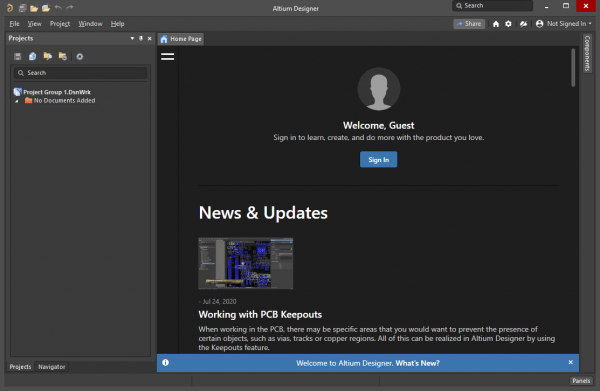

Altium Designer 26.8.1 Build 31 Full Version Free Download from the link given below: