

Overview of Wolfram SystemModeler 15.0:

Wolfram SystemModeler 15.0 Cracked is an easy-to-use, next-generation modeling and simulation environment for cyber-physical systems. Using drag-and-drop from a wide selection of built-in and expandable modeling libraries, you can create industrial-grade multi-domain models of your complete system. Adding the power of Wolfram Language gives you a fully integrated environment for quickly analyzing, understanding, and iterating on system designs. Drive insight, innovation, and results.
Wolfram SystemModeler 15.0 Key Features:
-
Drag, Drop, and Connect
Create models quickly and intuitively using System Modeler’s drag-and-drop approach. Take a component such as a transistor or a spring and drop it onto the canvas.
-
Multidomain Modeling
Real-world machines and systems are rarely confined to a single physical domain. Models can contain a combination of interconnected components from several domains that mimic real-world topologies.
-
Reusable Components
Individual components, including those you develop yourself, can be independently tested and reused, allowing you to quickly explore alternative designs and scenarios.
-
Included & Add-on Libraries
Extend your model seamlessly by adding components from a wide variety of domains. Features from colleagues, the System Modeler Library Store, and the Modelica community can be integrated into your model.
-
Object-Oriented Modeling with Modelica
Leverage the full power of the Modelica object-oriented language at the system level by viewing, modifying, and creating the physical equations and algorithms that underpin your components.
-
Programmatic Model Creation
Easily manage different model configurations with Wolfram SystemModeler 15.0 Full Version. With the click of a button, you can change the behavior and logic of your model.
-
Getting Started!
Take advantage of the many built-in resources to get started quickly. Built-in sample models are available for many industrial and educational domains, along with comprehensive documentation and model analysis suggestions.
-
One-click Simulation
Immediate exploration; in one click, you have access to all the values of each component of your model. Zoom into the area of interest and choose from built-in plot styles with a point-and-click interface.
-
Instant Animations
Plot the values of system variables with a single click. Plot multiple variables, create parametric plots, and choose from built-in plot styles with a point-and-click interface.
-
Personalize Your Plots
Plot custom variables, such as 3D plots and sensitivity bands, directly from simulation results. Results can be used in any Wolfram Language visualization feature.
-
Full Simulation Control
Get complete control over the simulation with an interactive notebook environment powered by Wolfram Language. Programmatically set initial conditions, parameter values, and input signal functions.
-
Simulate with Real Data
Set parameters and inputs using different data sources to realistically simulate the model. Programmatically access large Wolfram|Alpha datasets on weather, material properties, commodity prices, and hundreds more.
-
Real-time Simulation Interface
Get a better understanding of your model by viewing simulation results in real time. Send control signals and modify parameters of a running simulation using interactive controls, such as sliders and gauges, in the Wolfram Language.
-
Unlimited Analysis
Perform your own symbolic and numerical calculations by accessing the full model equation and simulation results of your model. Bring the full power of Wolfram Language to your model analysis.
-
Design & Optimization
Use the Wolfram Language to plot geometries of 3D mechanical systems, prototype equation-based custom components, and use built-in optimization routines to find optimal parameters and inputs.
-
Model Calibration
Explore the parameter space by running the System Modeler simulation from Wolfram Language.
-
Frequency Analysis
Perform FFT analysis on the output signal and use the results to design dampers and filters. Stimulate your model with any input signal to find the resonance peak.
-
Sensitivity Analysis
Simulate the model while drawing the sensitivity band of the system variable concerning the specified parameters. The plot of the sensitivity band is already attached.
-
Control System Design
Designing the controller for your system. A full range of control system functionality is built into the Wolfram Language, including stability analysis, visualization, and controller design.
-
Reliability Analysis
The full suite of Wolfram Language for reliability analysis, with functionality for reliability block diagrams, fault trees, and critical metrics, can be used with the model.
-
System Modeling in the Cloud
Use the system modeling feature in the cloud and analyze your system model on the desktop, your smartphone, or your tablet. Share your analysis with students, colleagues, or clients.
-
IMF Import and Export
Share individual components or libraries with others as functional breadboard units. Protect your intellectual property by exporting royalty-free models to various tools using Model Exchange or by attaching models to a standalone simulation engine using Shared Simulation.
-
Hardware and Software Connectivity
Put your model in the loop by directly connecting your hardware and software sources, and run the simulation.
-
Deploy Models
System model analysis functionality is built into all Wolfram Language products, both desktop and cloud. Take any model created in Wolfram SystemModeler Full Version and instantly share it with millions of Wolfram Language users.
-
Deploy the Simulations
The optimized simulation runtime compiled by the Autonomous Wolfram SystemModeler includes all numerical solvers and allows royalty-free deployment on desktops and servers.
-
Publish the Results
Run simulation models under different conditions and configurations and automatically generate custom reports based on simulation results.
What’s new in Wolfram SystemModeler 15.0?
Computation
- Improved accuracy and robustness of event-generating expressions.
- Check of local balance, allowing easier localization of mismatch between number of equations and variables.
- Improved implementation of delay, in particular with regards to discrete-valued signals.
- Support for passing records in the external C function interface.
- Performance improvements through expanded use of parallelism.
- Improved state selection.
- Visual Studio 2015 is no longer a supported compiler.
Modeling
- Replaceable components are listed as parameters, for improved usability and discoverability.
- Modelica Standard Library 4.1.0 is now the default and recommended version.
- Choose between different validation levels.
- Copy Icon and Diagram views as SVG.
- Export Icon and Diagram views as SVG files.
- Support for automatically sizing array connectors using connectorSizing.
- Use dependency information when renaming classes.
- Visualize and edit connection labels.
- Visualize and edit group images in parameter views.
- Rename and move groups between tabs in parameter views.
- Performance improvement when unloading libraries.
- Undo support in Modelica Input dialog.
- User confirmation before use of external functions.
- Automatically add or update uses annotations when pasting components.
- History of previous searches in search bars.
- Keyboard shortcuts for Case Sensitive and Whole Word options in Modelica Text View search.
- Put Modelica code on the clipboard when copying items from Icon and Diagram views.
- Improved Wayland support on Linux.
- Modelica Standard Library 3.2.3 is no longer supported.
- FMI 1.0 is no longer supported.
Documentation
- Replaceable types are listed in the Parameters section in documentation.
- Find licenses for a library in Documentation Center. »
Simulation
- Set value of inputs during real-time simulations.
- Allocate plot colors per experiment for easier comparison.
- Allow changing the color of plot markers.
- Highlight plot curves when hovering over the corresponding axis.
- Improved initial placement of plot marker labels.
- Support for string variables in the simulation result.
- Improved handling of guided Visual Studio compiler installation on Windows.
- Model plots in Modelica Standard Library 4.1.0.
Screenshots:
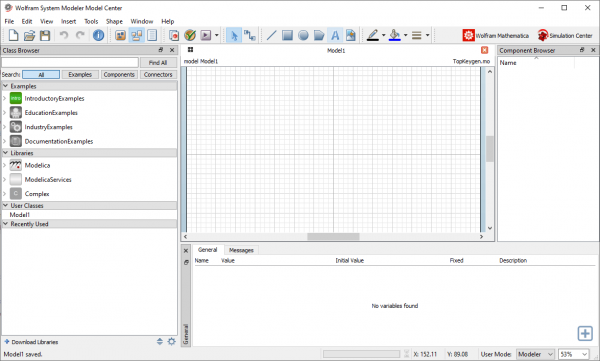
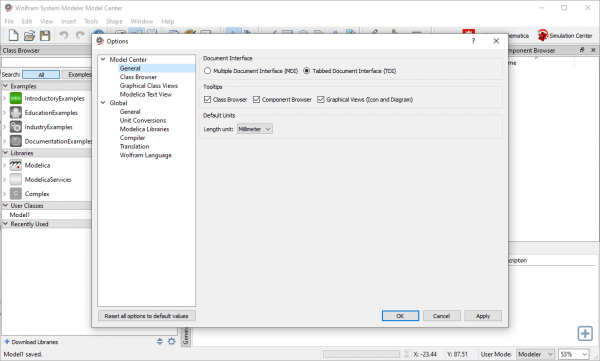
System Requirements:
- Operating System: Windows 7/8/10
- RAM: 2 GB RAM (4 GB recommended)
- Hard Disk Space: 200 MB or more
Wolfram SystemModeler 15.0 with Full Version Free Download from the link given below: