
Overview of 3DCoat 2026.12:
3DCoat 2026.12 Crack is an application that has all the tools you need to take your 3D ideas from digital clay blocks to production-ready organic or hard surface models. 3D-Coat is one of the software applications and the most advanced tool for creating detailed 3D models. While other apps in this market segment tend to specialize in specific tasks, such as digital sculpting or texture painting, 3DCoat offers advanced features for a wide range of tasks on the creative path.
In 3DCoat 2026.12 Full Version, the Paint, Sculpt, and Retopo workspaces have their native Mesh objects; however, the Sculpt (Workspace) objects share the Paint tools in the Paint workspace, using the texture paradigm known as Vertex Paint. Color, gloss, depth, and metallization information are stored at each point. This allows the artist to paint the current (sculpting phase of the project) or later (after baking the UV-mapped Retopo low poly mesh) PBR textures.
What is 3DCoat designed for?
The tools integrated into 3DCoat allow users to:
- Premium production-quality sculpture
- Voxel Modeling (for an extremely fast, flexible, and topology-less construction) and Poly-Modeling (Retopo Tool integrates Poly-Modeling functionalities, including Primitive and Kitbash models). This is a favorite for Concept Artists, who generally don’t care about low-poly topologies and want to build detailed models quickly, without having to fiddle around all day with the polys, edges, and vertices of traditional polygonal models, or fiddle with UV mapping.
- Create / Modify UV maps
- Create beautiful hand-painted textures or take advantage of the PBR Smart Materials library to quickly create photorealistic materials for your models
- Retopology is like a boss, with advanced automated or manual retopology tools.
- Render still images, movies, or turntable footage with 3DCoat’s default GPU rendering engine. There is also basic integration with Pixar’s Renderman (which requires a commercial Renderman or a free non-commercial license).
3DCoat 2026.12 Key Features:
Easy Texturing & PBR:
- Microvertex, Per Pixel, or Ptex painting approaches.
- Real-time physical rendering perspective with HDRL.
- Smart materials with easy configuration options.
- Several coats of paint
- Popular mixing mode
- Wacom or Surface Pen, 3Dconnexion mouse, and multitouch on Surface Pro are supported.
- Layer Group
- Close interaction with Photoshop.
- Texture size up to 16k.
- A quick calculation of the ambient occlusion and curvature map.
- Rich toolset for all kinds of painting tasks.
Digital Sculpting:
- Creation of voxels without topological constraints. Sculpt as you did with Clay.
- Complex Boolean operations with sharp edges. Fast kitbashing workflow.
- Dozens of fast and fluid sculpting brushes.
- Traditional digital sculpture.
- Adaptive dynamic tessellation with the Live Clay tool.
Modeling:
- Classic polygonal modeling is fully supported.
- Move, rotate, scale, extrude, insert, and other popular instruments.
- A complete 3D production pipeline is simplified.
- Splines and joints – a cool way to model quickly.
Retopo Tools:
- Automatic retopology (AUTOPO) with user-defined edge loops.
- Quick and easy-to-use manual retopo tool.
- Possibility to import a reference mesh for retopologization.
- Use your current low-poly network as the Retopo network.
- Retopo groups with color palettes for better management.
- Advanced Cooking Settings dialog box.
UV Mapping:
- Professional tools for creating and editing UV devices.
- Original Global Uniform (GU) unlock algorithm.
- Support and management of multiple UV sets.
- Supports ABF, LSCM, and Planar aperture algorithms.
- Individual island customization.
- Several chess screens.
- Finally, it is fast, easy, and fun to use.
Rendering:
- Physics-based rendering
- High Dynamic Range Lighting
- Reflection and screen light.
- Provide operator support
- Colored lights
- Render pass
- DOF and other effects
Concept Art Making:
- It all starts with a Concept! Now it is very convenient to use 3D software in the concept art production line. Usually, it starts with a coarse or detailed 3D block, separates the 3D objects, or even finishes the 3D scene with paint later in Photoshop or another 2D image editor.
- 3DCoat is ideal for creating 3D elements for concept art.
Scripting:
- You can record your actions on the primitives in the Sculpture Room. This way, you can perform repetitive actions of varying complexity just by running a recorded script.
- The script menu contains all the commands you need to create your script.
What’s new in 3DCoat 2026.12?
(Released on 28-07-2026)
- Non-destructive GPU node-based texturing – create editable materials, masks, filters, modifiers, and procedural effects using the new visual Node Editor;
- High-performance GPU nodes – procedural effects, mathematical operations, and noise generators are calculated directly on the graphics card;
- Texturing while sculpting – preview node-based materials on sculpt objects in real time, even before retopology or UV mapping;
- 3D lattice voxel structures – generate complex internal volumetric structures for 3D printing, engineering, and artistic workflows;
- Node-based procedural sculpting patterns – create complex volumetric and surface shapes and convert them into regular sculpt objects for further editing;
- Near 30 material channels – the updated PBR/PBM system supports advanced material properties, light interaction, and refraction effects;
- Procedural materials and masks library – new and legacy Smart Materials have been converted to the node-based system, with a built-in library of masks included;
- Quick Access toolbar search – text-based tool search has been added to the Sculpt and Modeling workspaces;
- Interactive node transform gizmo – control the position, rotation, and scale of textures, lattices, and volumetric patterns directly in the viewport;
- Splitter tool – split models into separate parts, with each resulting part automatically placed on its own layer;
- Lofted Surface for the On-Plane tool – create lofted surfaces using curves and sculpt directly on them with voxel brushes;
- Hybrid Mesh for On-Plane Brush Control – convert retopology meshes into Hybrid Meshes and use them as surfaces for voxel sculpting;
- Parametric Hybrid Modeling – create complex editable models using curves, control handles, and adjustable parameters;
- Group Tree in the Retopo and Modeling Rooms – organize objects hierarchically and transform, copy, or manage entire object branches;
- Pose tool improvements – new deformation modes and the ability to snap a mesh to an object’s surface were added;
- Bevel improvements – a new Profile Shape option has been added to the Bevel tool;
- LWO3 import and GLB export – support for LightWave 3D files and improved Blender integration has been added.
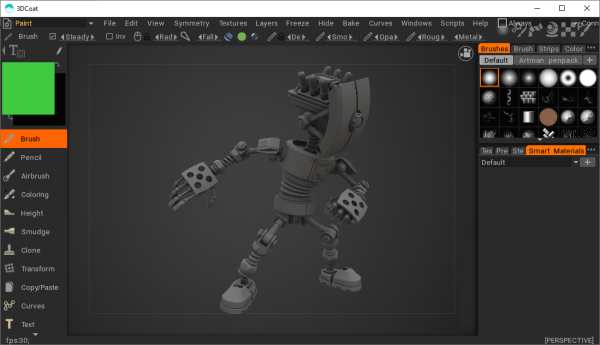
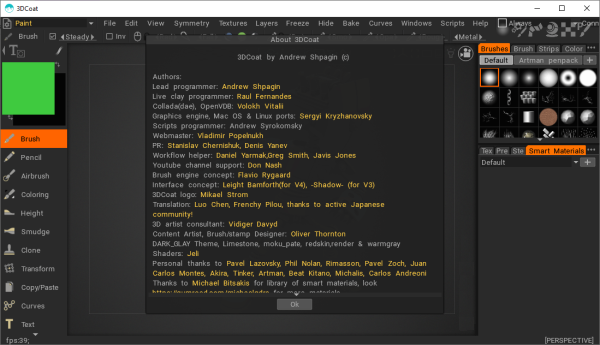
Screenshots:
System Requirements:
- Operating System: Windows 7/8/10
- Processor: Multicore Intel Series or above, Xeon, or AMD equivalent
- RAM: 4GB (8GB or more recommended)
- Hard Disk Space: 4GB or more recommended
3DCoat 2026.12 Full Version Free Download from the link given below: